
Introduction
Feng Shui isn’t about luck or superstition. It is a systematic way of designing your space so that energy flows smoothly through your home, office, and life.
In simple terms, good Feng Shui means your environment supports you mentally, emotionally, and financially. Bad Feng Shui means it works against you.
This guide brings together Master Kevin Foong’s 24+ years of experience helping people across the world create spaces that feel balanced, prosperous, and alive. Every principle, example, and tip you’ll read here is drawn from Kevin’s real-life case studies and professional practice, from modern Singapore apartments to global corporate offices.
What You’ll Learn Inside
Learn everything about Feng Shui from the foundations to its advanced applications through Kevin’s expert lens in the following sections:
1.What Is Feng Shui?
Learn where it all began, from ancient China to modern Singapore. And understand how Qi, Yin & Yang, and the Five Elements shape the way energy flows through any environment.
2.Core Feng Shui Principles Explained
Understand the key forces behind Feng Shui, including the Five Elements, Yin–Yang balance, and the concept of Qi explained in an easy-to-understand way.
3.Types of Feng Shui Schools & Methodologies
Explore the main classical systems Kevin uses: Form School, San He, Flying Stars, and Eight Mansions and how they complement each other.
4.Practical Uses of Feng Shui in Everyday Life
Get quick, actionable Feng Shui tips you can apply immediately, from arranging your bedroom to improving your focus at work.
5.Home Feng Shui Best Practices
Discover in-depth best practices for entrances, bedrooms, kitchens, living rooms, and bathrooms. Kevin explains what truly matters in creating a supportive home.
6.Office Feng Shui Best Practices
Optimise your workspace for focus, creativity, and success. Learn the same principles Kevin uses when advising top executives and Fortune 500 companies.
7.Feng Shui Prices in Singapore & Worldwide
Understand what a professional Feng Shui consultation costs, and what influences pricing across different countries.
8.Feng Shui Crystals & How They Are Used
A clear explanation of how crystals can enhance, but never replace, proper Feng Shui design.
9.Where to Learn Feng Shui
Kevin’s recommended books, online courses, and YouTube channels for anyone who wants to go deeper.
10.Popular Feng Shui Masters Around the World
Meet some of the most respected Feng Shui masters in Asia and the West, and learn what makes their approaches unique.
11.How to Choose a Feng Shui Master
What to look for in a Feng Shui consultant, what to avoid, and how to choose the right master for your goals.
12.Frequently Asked Questions
Answers to the most common Feng Shui questions, from “Is Feng Shui real?” to “Which direction should my bed face?”
Section 1: What Is Feng Shui?
Feng Shui (風水) is an ancient Chinese practice that studies how the energy of your surroundings called Qi (Chi) affects the way you feel, live, and succeed.
The goal of Feng Shui is simple: create balance between people and their environment so that energy flows smoothly through your home or workspace.
In Simple Terms
Feng Shui is about:
- Placement: Where things are positioned. Especially doors, beds, desks, and stoves that all influence energy flow.
- Balance: Achieving harmony between Yin & Yang (quiet vs active) energies.
- Elements: Using the Five Elements (Wood, Fire, Earth, Metal, and Water) to encourage growth, stability, and positive flow in different parts of your life, such as health, wealth, or relationships.
- Direction & Time: Understanding how the direction your home or room faces and the period in which it was built influence its overall energy. These are calculated using a Feng Shui compass called the Luo Pan.
When these factors work together, your space feels calm, supportive, and energising.
When they clash, you may experience stress, poor focus, or stagnation in different areas of life, even if everything “looks” fine on the surface.
In essence, Feng Shui is not superstition or interior design. It is the art and science of aligning your surroundings with natural energy flow. As Kevin often says “When the energy in your space flows well, life follows the same way: easier, smoother, and more abundant.”
Section 2: Core Feng Shui Principles Explained
Feng Shui is built on a few timeless principles that explain how energy moves through the world and how we can work with it, not against it.
Master Kevin Foong often teaches these as the “four building blocks” of Feng Shui.
1.Qi (Chi): The Flow of Energy
What it means:
Qi is the invisible life force that flows through people, buildings, and nature. When Qi moves gently and evenly, life feels smooth and opportunities come easily. When it’s blocked or rushed, we feel stressed or stuck.
How to apply it:
- Keep pathways open and uncluttered so energy can circulate.
- Avoid doors or windows directly facing each other. Qi enters and exits too quickly.
- Let in fresh air and natural light to refresh the energy daily.
In short: where Qi flows, life grows.
2.Yin and Yang: The Balance of Opposites
What it means:
Everything in life has two sides: Yin (calm, quiet, cool, dark) and Yang (active, bright, warm, lively). Neither is better; both are essential. Problems arise only when one dominates for too long.
How to apply it:
- Resting areas like bedrooms or meditation corners should feel more Yin.
- Bright, busy spaces such as kitchens or living rooms should feel more Yang.
- Mix textures and lighting to keep both energies in harmony.
Balanced environments create balanced minds.
3.The Five Elements: Wood, Fire, Earth, Metal, Water
Each element represents a different quality of energy. Together, they form the rhythm of creation and control that keeps life in balance.
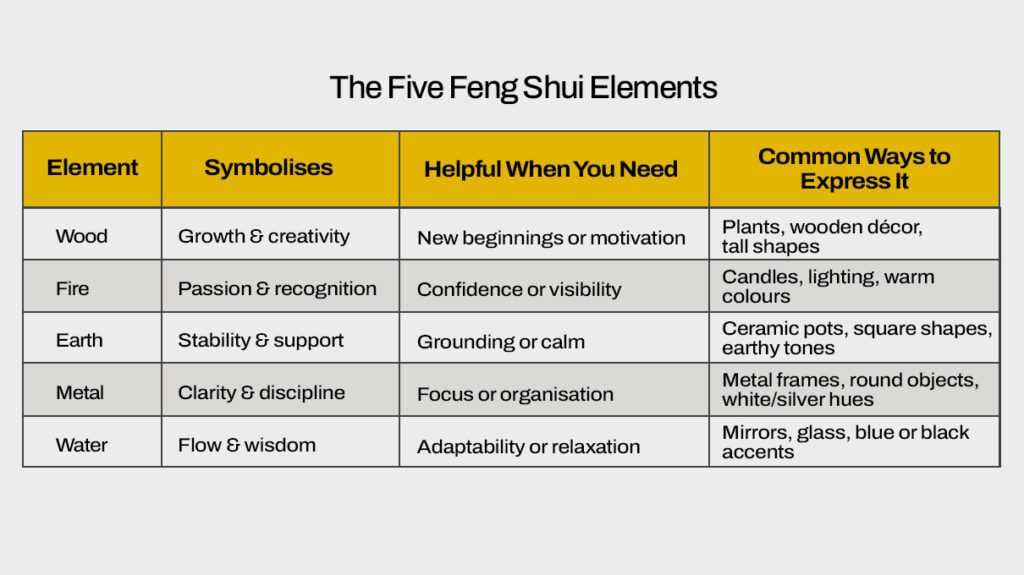
When one element is missing or excessive, small adjustments can restore balance, just as nature always seeks equilibrium.
4.Direction and Time: The Hidden Forces
In classical Feng Shui, where a building faces and when it was built both influence its energy pattern.Using a specialised compass called the Luo Pan, masters like Kevin measure the property’s facing direction and match it with time cycles known as Periods (we are currently in Period 9, 2024 to 2043).This is what makes Feng Shui dynamic: energy isn’t static, it shifts with time.
Summary of Core Feng Shui Principles
These four ideas: Qi, Yin & Yang, the Five Elements, and Direction & Time form the foundation of every Feng Shui analysis. Once you grasp them, the rest of Feng Shui becomes much easier to understand.As Kevin says: “Feng Shui always starts with the basics. When you get the fundamentals right, every cure and calculation starts to make sense.”
Section 3: Types of Feng Shui Schools & Methodologies
Over thousands of years, Feng Shui developed into several schools of thought.
Each one looks at energy from a slightly different angle, but all share the same goal: to create harmony between people and their environment.
Master Kevin Foong often explains them as “different lenses that reveal different parts of the same truth.”
1.Form School (Xing Shi Pai)
Focus: The visible landscape and physical surroundings.Form School studies what you can actually see, such as mountains, roads, rivers, and even nearby buildings.
Key idea: The land around you determines how well Qi (energy) is supported, protected, and gathered.
In practice:Back support (Black Tortoise):
- Ideally, there should be something solid and stable behind your home or building, like a gentle hill, a cluster of trees, or a taller building.
- This gives a sense of “backing” or long-term support, like having someone watch your back.
- When the rear is too open or exposed, people may feel insecure or unsupported in life or business.
Front openness (Red Phoenix):
- The area in front of your home or main entrance should be open, bright, and unobstructed, such as a clear road, garden, or open courtyard.
- This open space allows energy (and opportunities) to flow in freely and symbolises future prospects.
Left side (Green Dragon):
- The left side of the property (as you stand facing out from your front door) should ideally have a slightly higher or more active feature, for example, a taller building, slope, or tree line.
- This represents helpful, uplifting energy that supports growth and progress.
Right side (White Tiger):
- The right side should have a slightly lower or quieter feature, something shorter, calmer, or less active, like a low wall or small garden.
- This represents gentle, protective energy that keeps things balanced and prevents conflicts.
When all four directions work together, solid support behind, open space in front, balance on the sides, Qi gathers harmoniously around the property.
2.Compass School (Li Qi Pai)
Focus: The invisible forces of direction, time, and energy patterns.
Here, masters use the Luo Pan (Feng Shui compass) to measure exact directions and calculate how Qi interacts with the property.
Within Compass School, several major systems exist. Kevin uses the following most often:
a.San He (Three Combinations)
Focus: The relationship between the land’s natural features, mountains (or tall structures), water (or roads), and direction, and how they work together over time.
What this means in practice:
- In classical Feng Shui, mountains represent supportive, stable energy. In modern cities like Singapore, this could also mean tall buildings or elevated land behind a property that symbolically “protect” it.
- Water represents movement and opportunities. These include rivers, canals, swimming pools, or even major roads that curve or flow towards a property.
- The direction of flow (of water or road traffic) matters: water flowing toward the home or site brings wealth; water flowing away can symbolise loss of energy or opportunities.
- The compass direction ties everything together, determining how mountain and water features interact with the property’s orientation.
San He analysis is especially useful for:
- Landed homes in Singapore, where the external landscape can be adjusted or enhanced (driveways, garden slopes, water features).
- Larger commercial buildings or industrial sites, where the placement of entryways, roads, or water bodies has a big influence on energy flow.
As Kevin often says:
“San He teaches us to see how land breathes: where energy gathers, where it flows away, and how we can guide it to stay.”
b.San Yuan (Three Cycles) and the Flying Stars System
Focus: How the energy of a building changes over time.
In San Yuan Feng Shui, time is divided into nine “periods”, each lasting about 20 years. Every period carries the energy of one of the Five Elements.
A building’s “birth chart” is created from the year it was built and the direction it faces.
This chart shows which parts of the property attract good energy and which need balancing in that particular time cycle.
Current period (2024 to 2043): Period 9, the Fire element
- Fire energy represents visibility, passion, inspiration, and technology.
- During this period, spaces that emphasise light, warmth, and digital connectivity tend to thrive.
- Industries linked to media, communication, tech, and creativity are naturally favoured.
- In homes and offices, it’s important to strengthen Fire energy with brightness, lighting, and open, lively areas, while ensuring calm zones remain balanced so the energy doesn’t become too “hot.”
Kevin often explains it this way: “Each period brings its own theme. Period 9 is the Fire age. It rewards clarity, innovation, and anything that helps you stand out.”
This system helps masters forecast how a property’s luck and function will shift over the years and guide adjustments to keep the energy supportive.
c.Eight Mansions (Ba Zhai)
Focus: A personalized system that bridges your innate energy with the energy of your space to optimize specific areas of your life.
Eight Mansions is one of the most practical and personalized systems in Feng Shui. It connects a person’s date of birth with the energetic blueprint of their home or workspace, moving beyond a one-size-fits-all approach. The core question it answers is: “How does this specific space interact with my personal energy, and how can I arrange it to support my unique goals?”
How it Works: The Two Layers of Analysis
- The Personal Layer: Your Life Gua (Ming Gua)
- Based on your year of birth, you calculate your Ming Gua (Kua Number). This reveals whether you belong to the East Group or West Group and, more importantly, identifies your four Auspicious and four Inauspicious directions.
- The Property Layer: The House’s Energetic Blueprint
- Every property has a facing and sitting direction. The “sitting” direction (what the building backs onto) determines its group (East or West Group house).
- Fundamental Harmony is achieved when your personal group matches your home’s group—for example, an East Group person living in an East Group house. This creates a solid, supportive foundation.
- Advanced Diagnosis: The Eight Stars
- Beyond the basic group match, we analyze the interaction between the house’s sitting direction and the location of its main door. This creates a detailed energy map, assigning one of eight “stars” to different sectors of the home. These stars are powerful energies that influence specific life areas:
- Sheng Qi (Vital Breath): For success, wealth, and dynamic growth.
- Tian Yi (Heavenly Doctor): For health, stability, and gentle accumulation.
- Yan Nian (Longevity): For relationships, commitment, and protection.
- Fu Wei (Stability): For peace, mental clarity, and your personal energy anchor.
- The four inauspicious stars (Jue Ming, Wu Gui, Liu Sha, Huo Hai) indicate areas best used for storage, bathrooms, or other low-activity functions.
- Beyond the basic group match, we analyze the interaction between the house’s sitting direction and the location of its main door. This creates a detailed energy map, assigning one of eight “stars” to different sectors of the home. These stars are powerful energies that influence specific life areas:
In Everyday Life: From Fundamentals to Fine-Tuning
Kevin uses Eight Mansions not just for fundamental compatibility but for precise, personalized fine-tuning.
- Fundamental Layout: After assessing the main property energy, he uses Eight Mansions to assign room functions. The master bedroom is ideally placed in the Yan Nian or Tian Yi sector for harmony and health, while the home office thrives in the Sheng Qi sector.
- Personal Positioning: This is where the system becomes truly personalized. Even within a room, you can orient yourself to receive your best personal energy.
- Bed: Position so the crown of your head points toward your Yan Nian or Fu Wei direction to improve rest and relationship harmony.
- Desk: Face your Sheng Qi or Tian Yi direction while working to enhance focus, opportunities, and career growth.
- Stove: Align the burners or your facing direction while cooking toward a supportive direction like Tian Yi to symbolically “nourish” the family’s health and wealth.
As Kevin often explains: “The East/West Group tells us if the house is on your team. The Eight Stars analysis is the playbook that shows us how to win. By bridging your personal energy with your home’s hidden structure, we can make the space not just harmonious, but actively working for you.”
How They Work Together
A skilled practitioner never uses just one school. Kevin’s approach always starts with the big picture and moves inward:
Form School – Assess the external environment first. Look for natural support (mountains or tall buildings behind) and open space in front where energy can gather. The 400 metres surrounding the house within its eight direction affects the house capacity in terms of relationships, health, financial growth, or problems.
San He – Verify whether the surrounding landforms and directions of mountains, roads, or water flow support the property’s energy.
- If the flow is not beneficial, for example, if a road or river directs energy away from the home instead of gently toward it, Kevin recommends practical remedies such as changing the main entrance orientation, adjusting pathways, or using landscaping features to redirect Qi.
Flying Stars (San Yuan) – Analyse how the building’s internal energy changes over time, using the property’s facing direction and construction period.
Eight Mansions – Personalise the layout for each occupant’s birth data and usage, ensuring bedrooms, desks, and stoves align with their favourable directions.
This layered approach ensures that every recommendation is practical, precise, and fully tailored to both the property and the people living or working there.
In Summary:
Each Feng Shui school adds a different layer of insight:
- Form School – The physical foundation.
- San He – The land’s deeper energy.
- Flying Stars – The movement of time.
- Eight Mansions – Personal alignment.
Together, they form a complete picture, blending Earth, Heaven, and Human energy into one harmonious system.
As Kevin often says: “Good Feng Shui is never about choosing one method. It’s about combining the right ones, at the right time, for the right person.”
Section 4: Practical Uses of Feng Shui in Everyday Life
Feng Shui is a living art you can apply daily, to improve how your space feels and how smoothly life flows. These are the most practical ways to bring harmony into your home, work, and personal life with Feng Shui.
Feng Shui at Home: Where Energy Begins
Your home is the foundation of your energy.
Good Feng Shui starts with the simplest habit: keeping your space clean and clutter-free. Stagnant energy can’t move through mess and neglect.
Quick Wins:
- Main Door (“Mouth of Qi”) – Keep it bright, clear, and easy to open. A tidy, welcoming entry allows new opportunities to enter your life.
- Bedroom – Choose calm colours, solid support behind your bed, and soft lighting. The bed should face the door (but not directly in line with it) so you feel safe and rested.
- Kitchen & Stove – Treat the stove as your “wealth generator.” Keep it clean, use all burners regularly, and avoid placing it directly opposite a sink or fridge.
- Study or Workspace – Sit in a commanding position with a solid wall behind you. A clutter-free desk equals a clearer mind.
Start with these basics before moving on to the deeper methods in Section 5.
Feng Shui at Work: Energy That Drives Performance
Your workspace mirrors your state of mind. When the energy is balanced, focus and productivity come naturally.
Simple Adjustments:
- Position your desk so you can see the door without being directly in front of it.
- Keep cables, papers, and unused items organised; clutter blocks flow.
- Add a healthy plant for growth energy and clean air.
- Ensure good lighting, natural light if possible, or a warm desk lamp for comfort and vitality.
- A calm, well-arranged space invites smoother teamwork and clearer decision-making. (See Section 6 for an in-depth guide to office Feng Shui.)
Feng Shui for Wealth & Prosperity
True wealth Feng Shui begins outside your home, not in your décor. Prosperity flows naturally when the environment supports it.
Key Ideas:
- A solid backing (hill, tall building, or wall) behind your home gives stability.
- An open, welcoming space in front allows opportunities to gather.
- Inside, ensure energy moves gently, no cluttered hallways or blocked paths.
- Keep the main door and kitchen stove in top condition; these represent how you “receive” and “generate” abundance.
Symbolic items like plants, crystals, or fountains can complement this, but only after the fundamentals are right.
Feng Shui for Love & Relationships
Love thrives in calm, balanced, and welcoming spaces. Your home should reflect partnership, not solitude.
Practical Steps:
- In the bedroom, use pairs. Two pillows, two lamps, equal space on both sides of the bed.
- Remove reminders of past relationships or lonely imagery.
- Avoid working in the bedroom; it mixes career energy (Fire) with rest energy (Earth).
- Choose soft, natural colours like beige, pink, or light earth tones to create warmth.
When your home feels open and nurturing, your relationships naturally strengthen.
Feng Shui for Health & Well-Being
Health begins with good energy flow and fresh air. The goal is to let your space breathe.
Simple Checks:
- Keep the centre of your home clear and well-lit: this is the heart (Tai Qi) of the house.
- Fix leaks, flickering lights, or anything broken immediately; disrepair drains vitality.
- Let in natural light and airflow daily.
- Keep the bedroom electronics-free to support deep rest.
A balanced environment refreshes your body, settles your mind, and builds resilience from the inside out.
By applying these straightforward principles, you are already practising authentic Feng Shui, aligning your environment to support your goals, your relationships, and your peace of mind.
The next sections will guide you step-by-step through Home Feng Shui Best Practices and Office Feng Shui Best Practices, where Kevin’s professional insights come to life in detail.
Section 5: Home Feng Shui Best Practices
Your home constantly exchanges energy with you. When the layout supports that flow, everything in life, rest, health, and relationships, feels lighter and more balanced.
These principles apply to anywhere you live, from a Singapore HDB flat to a landed property.
1.The Entrance & Main Door: Where Energy Enters
The main door is the mouth of Qi. It decides what kind of energy (and opportunities) enter your home.
Do this
- Keep the entry bright, clean, and unobstructed.
- Make sure the door opens fully and easily: no squeaks or clutter behind it.
- Place a soft mat or a symbol of welcome (plant, artwork, gentle lighting).
Avoid
- A wall, staircase, or toilet directly facing the door: Qi rushes in and escapes or drains too fast.
- A mirror facing the door; it bounces good energy back out.
Kevin’s Tip:
“When you step inside, it should feel like the home is breathing in fresh energy, not exhaling it.”
2.Bedroom Feng Shui: For Rest and Relationships
The bedroom represents Yin energy: calm, recovery, and connection.
Do this
- Place the bed in the commanding position: headboard against a solid wall, clear view of the door, but not directly aligned with it.
- Use muted, natural colours and soft textures.
- Keep the space under the bed clear for free airflow.
- Use matching bedside tables or lamps to promote balance between partners.
Avoid
- Sleeping with your feet pointing directly to the door (“coffin position”).
- Mirrors reflecting the bed; they can cause restlessness.
- Work desks or exercise gear in the same room, they introduce active Yang energy.
3.Living Room Feng Shui: For Gathering and Harmony
This is the home’s social heart, where family and guests connect.
Do this
- Arrange seating in gentle curves or L-shapes so conversation flows easily.
- Provide a clear view of the main door from where people usually sit.
- Keep pathways open; avoid pushing all furniture against the walls.
- Add plants or natural elements to bring vitality.
Avoid
- Sharp furniture corners pointing at seating areas.
- Overly dominant TVs or electronics. They steal focus and increase Yang energy.
4.Kitchen & Dining Area Feng Shui: For Health and Prosperity
The kitchen symbolises nourishment and wealth.
Do this
- Keep the stove spotless and functional; use all burners to “activate” prosperity.
- Ensure the cook can see the entrance while cooking (command position).
- Balance Fire (stove) and Water (sink / fridge) by avoiding direct opposition.
- Keep food stored neatly; abundance should look organised, not chaotic.
Avoid
- A stove directly beside or under a window: wealth energy “leaks out.”
- Bathrooms sharing a wall with the stove, if possible.
Dining Tip:
A round or oval dining table symbolises unity; ensure every seat has comfortable space.
5.Bathroom Feng Shui: Managing Energy Drain
Bathrooms represent water flowing away, a natural outflow that must be managed.
Do this
- Keep them clean, bright, and well-ventilated.
- Always close the toilet lid and door when not in use.
- Use earth-tone décor (beige, sand, light brown) to stabilise water energy.
Avoid
- Leaky taps or constantly running water: they symbolise financial or emotional drain.
- Mirrors directly facing toilets or reflecting the door.
6.Decluttering & Storage: Maintaining Positive Qi
Clutter is the fastest way to block energy.
Simple rules
- Keep storage organised and hidden.
- Do a quick 10-minute tidy each day rather than a monthly overhaul.
- Let go of items you neither use nor love: stagnant belongings equal stagnant Qi.
- Pay special attention to corners, cupboards, and spaces under beds or sinks.
7.Garden & Indoor Plants: Inviting Growth Energy
Even a small balcony can channel nature’s vitality.
Do this
- Choose healthy, rounded-leaf plants such as jade, peace lily, or money plant.
- Keep them well-trimmed and dust-free.
- Place taller plants at the sides of entrances to “guard” and soften energy.
Avoid
- Thorny or spiky plants (like cactus) in tight indoor areas: they create defensive energy.
- Dead or dying plants; remove them immediately.
8.Common Home Feng Shui Mistakes to Avoid
- Ignoring repairs: leaks, squeaky doors, or broken lights signal neglected energy.
- Using extreme colours or décor themes that clash (too much red = restless; too much black = heavy).
- Allowing clutter to build at the main entrance or central area of the home.
In Kevin’s Words:
“Good Feng Shui at home isn’t about buying lucky objects. It is about keeping the environment alive, supportive, and in sync with the people who live there.”
Section 6: Office Feng Shui Best Practices
A well-designed office doesn’t just look good. It supports focus, collaboration, and steady growth.
Kevin’s approach treats Feng Shui as strategic environmental design: every placement influences how energy and ideas move through the workplace.
1.Position Your Desk for Better Energy and Productivity
Your desk is your personal power spot. Its position shapes how you feel and perform each day.
The Ideal (Command Position):
- Sit where you can see the door without being directly in line with it.
- Keep a solid wall behind you, symbolising strong backing from colleagues and management.
- Have open space in front for expansion and opportunities.
Avoid:
- Back facing the door → creates uncertainty and stress.
- Desk directly facing the door → leads to scattered focus and constant interruptions.
- Sitting under beams or air-con vents → causes “cutting Qi,” resulting in pressure or fatigue.
Fix if you can’t move the desk:
Place a small mirror to see the door, or use a tall plant or low cabinet behind your chair for extra “support Qi.”
Kevin says: “The person in command of the room usually has the clearest view of the door and their future.”
2.Use Lighting, Colours and Plants to Stay Energised at Work
Modern offices often feel artificial and draining. This triad of lighting, colours and plants re-energises the space.
Lighting:
- Prioritise natural light; open blinds whenever possible.
- Replace harsh fluorescents with warm-white LED desk lamps to reduce glare and tension.
Colours:
- Neutrals (white, beige, grey): encourage clarity and focus.
- Blue & green accents: improve communication and calm.
- Touches of yellow: spark creativity; use sparingly.
- Avoid excessive red — it can heighten aggression.
Plants:
- Introduce at least one healthy, broad-leaf plant (money plant, peace lily, jade).
- Keep it vibrant and dust-free; remove dying plants immediately.
- Plants near computers or corners soften sharp edges and balance energy flow.
3.Arrange Office Furniture for Smooth Energy Flow
Think of energy like water. It should move gently and nourish every corner.
Do this:
- Keep walkways clear from entrance to key desks, opportunities need a clear path.
- Arrange chairs at gentle angles for discussions; direct opposition creates conflict.
- Use round or oval meeting tables to encourage unity.
- Hide cables and clutter to prevent “tangled Qi.”
Avoid:
- Sharp furniture corners pointing at seats (“poison arrows”).
- Oversized furniture blocking doors or windows.
- Dark, unused corners. (Brighten them with light or art.)
4.Office Feng Shui Tips for Business Owners and Team Leaders
The energy of the leadership sets the tone for everyone else.
Key placements Kevin looks for:
- CEO/Manager’s desk: Should be in the commanding position, farthest from the door yet with a clear view of it.
- Finance area: should sit in a stable, quiet corner, symbolising security.
- Sales & marketing: closer to the front, where lively incoming Qi activates growth.
- Reception: bright, open, and welcoming the company’s “mouth of Qi.” Rounded counters invite positive first impressions.
“If the front of your office feels tired or blocked, so will your revenue flow,” Kevin often reminds clients.
5.Common Office Feng Shui Challenges in Singapore (and How to Fix Them)
Dense high-rise environments present unique Feng Shui issues.
Limited space / cubicles:
- Use low partitions or glass panels to maintain openness.
- Add mirrors or light colours to expand perceived space.
Lack of natural light:
- Use full-spectrum bulbs and indirect lighting to mimic daylight.
- Encourage breaks near windows or communal areas with sunlight.
External Sha Qi (“killing energy”):
- Skyscrapers or roads pointing directly at windows can send harsh energy.
- Mitigate with blinds, sheer curtains, or plants along the window line.
Noise & stress:
- Introduce soft materials (rugs, acoustic panels) to absorb excessive Yang energy.
- Create one calm breakout area for mental reset.
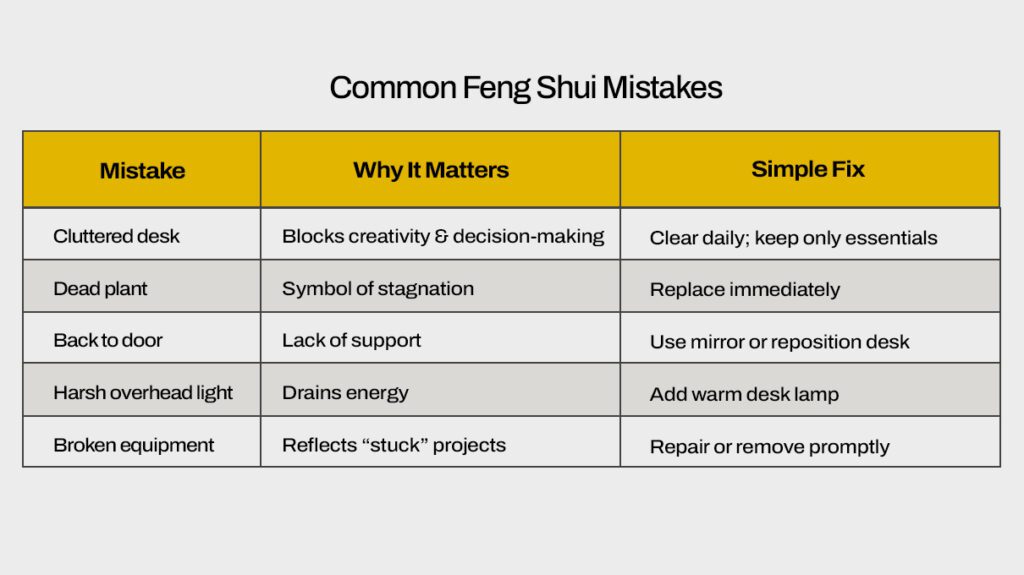
6.Common Feng Shui Mistakes at Work and Simple Fixes
Final Note from Kevin:
“Office Feng Shui is about setting up your space so energy, ideas, and people move smoothly. When the flow is right, meetings feel easier, decisions clearer, and results faster.”
Section 7: Feng Shui Prices in Singapore & Worldwide
Investing in a professional Feng Shui consultation is a meaningful step towards creating a more balanced and supportive environment. However, pricing can vary widely, from a few hundred dollars to tens of thousands, depending on the master, methodology, and project scope. Understanding what drives these costs will help you choose a consultant confidently and avoid overpaying for vague promises.
What Affects Feng Shui Pricing
Feng Shui fees aren’t standardised. They depend on several key factors:
- Experience & Reputation
- A seasoned Master with decades of experience, a strong client base, and proven results often commands premium fees.
- Newer practitioners or those building their portfolio usually charge more modestly.
- Lineage & School of Thought
- Consultants trained in highly respected classical lineages (e.g. Flying Star, San He, or Ba Zhai Feng Shui) may charge more for their depth of technical mastery.
- Scope of Service
- Basic Audit: A general overview of energy flow and simple recommendations.
- Detailed Analysis: Involves birth date (Ba Zi) and property direction (Flying Star) calculations, giving precise guidance for wealth, health, and relationships.
- Follow-ups & Annual Updates: Many clients schedule yearly reviews to adjust for changing time cycles and energies.
- Property Type & Size
A compact apartment naturally takes less time to analyse than a multi-storey landed home or corporate office.
- Location
Fees reflect the local cost of living and demand. Consultations in cities like Singapore or Hong Kong are generally higher than in smaller towns.
Typical Feng Shui Consultation Fees in Singapore
Singapore’s market is broad, ranging from entry-level practitioners to elite masters.
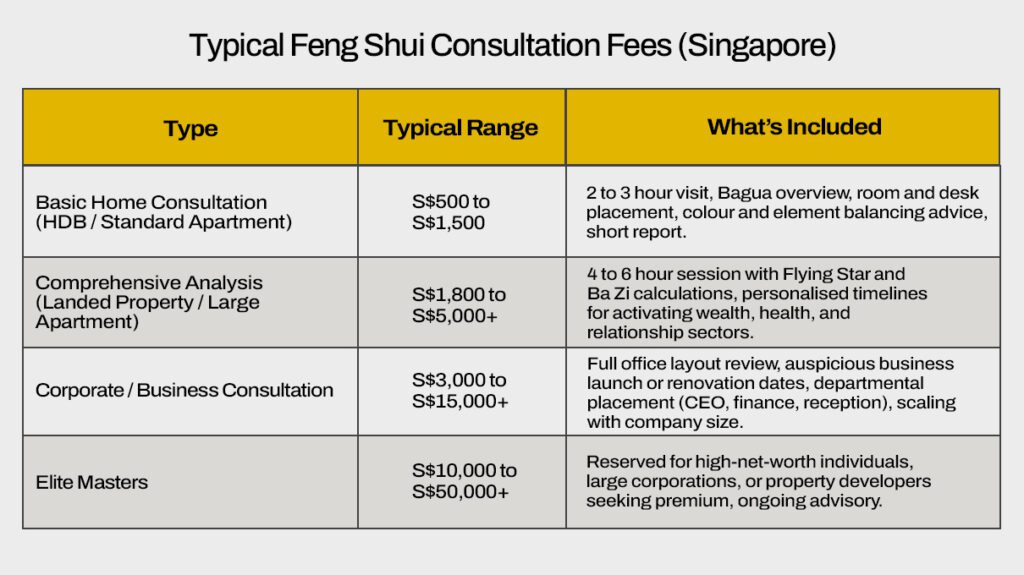
Kevin notes: “As with any professional service, pricing reflects both expertise and responsibility. A proper consultation should give you clarity, not confusion or superstition.”
Feng Shui Prices Across Asia
Because Feng Shui has deep roots in Asia, pricing varies significantly by country and cultural demand.
Hong Kong – The Premium Market
- Among the world’s highest fees due to intense competition for auspicious spaces.
- Range: HKD $5,000 (~S$850) for small flats to HKD $100,000+ (~S$17,000) for top-tier masters.
Malaysia – More Moderate Pricing
- Strong market with affordable options.
- Range: RM 1,000 – RM 5,000 (~S$285 – S$1,430) for comprehensive home consultations.
Mainland China & Taiwan – Extremely Wide Range
- Vast market from local practitioners to international celebrity masters.
- Range: CNY 1,000 (~S$190) to CNY 100,000+ (~S$19,000+), depending on experience and city.
Feng Shui Prices in Western Countries
In the West, Feng Shui is often approached as part of interior design and wellness consulting, which shapes how services are priced.
United States & Canada
- Many consultants charge hourly or offer fixed packages.
- Range: US$150 to US$500 per hour, or US$450 to US$2,500+ per project.
- High-profile consultants in major cities (New York, Los Angeles) can charge US$10,000+ for full-scale projects.
United Kingdom & Australia
- Similar to the North American model.
- Range: £150 to £400 per hour or A$200 – A$550 per hour.
- Full residential consultations: £500 to £3,000 depending on scope.
What You Are Really Paying For
When hiring a Feng Shui consultant, you are investing in:
- Expert interpretation: Turning complex energy charts into clear, actionable recommendations.
- Personalisation: Aligning adjustments with your unique goals, property, and timing.
- Peace of mind: Knowing your space supports your success, health, and well-being.
The best consultant won’t just rearrange furniture, they’ll help you make strategic decisions that support long-term growth and harmony.
Section 8: Different Feng Shui Crystals & How They Are Used
Crystals have long been valued in Feng Shui as natural conductors of the Earth’s energy. Formed over thousands of years under intense pressure, each crystal carries a unique vibration that can fine-tune or stabilise the energy (Qi) in a space.
Used intentionally, crystals can enhance clarity, harmony, and abundance. However, one has to take note that crystals are enhancers, not cures. A crystal cannot fix poor architectural Feng Shui such as a bed under a beam or a main door facing a toilet. It can, however, refine and strengthen the existing energy when the fundamentals are right.
How to Use Feng Shui Crystals Effectively
- Set a Clear Intention
Hold the crystal before placing it and state your purpose aloud. For example:
“I program this crystal to bring calm and clarity to my workspace.”
Intention focuses the energy and tells the crystal what to do.
- Choose Clarity and Quality
A clear, well-formed stone transmits energy more effectively than a chipped or dull one.
It doesn’t need to be expensive. What matters is that it feels right to you.
- Cleanse Regularly
Crystals absorb environmental energy and need periodic cleansing to stay vibrant.
Try:
- Leaving them under moonlight, especially during a full moon.
- Smudging with sage or palo santo smoke.
- Burying in sea salt or clean soil for 24 hours.
- Place with Purpose
Placement determines impact. Use the Bagua map to match each crystal with the area of life you wish to enhance: wealth, relationships, health, or career.
Essential Feng Shui Crystals and Their Uses
1.Clear Quartz – The Master Healer
Energy: Amplifies focus, clarity, and intention.
How to use:
- On your desk to sharpen concentration.
- In the Career area (North) to clarify your professional path.
- In any stagnant corner to clear and recharge Qi.
2.Amethyst – For Calm and Spiritual Awareness
Energy: Promotes peace, relaxation, and intuition.
How to use:
- In the Knowledge & Wisdom (Northeast) zones or Helpful People & Travel (Northwest) zones to deepen insight and attract mentors.
- A cluster in the bedroom or living room to create a serene atmosphere.
- Tip: Avoid using too much Amethyst in highly active areas like home offices; its calming energy can slow momentum.
3.Citrine – The Merchant’s Stone of Abundance
Energy: Attracts wealth, motivation, and optimism.
How to use:
- In the Wealth & Abundance corner (Southeast).
- In the Fame & Reputation (South) area to strengthen confidence and credibility.
- Keep a piece in your wallet or cash register to encourage financial flow. (Natural Citrine is pale yellow; heat-treated Amethyst also works effectively.)
4.Rose Quartz – The Stone of Love and Compassion
Energy: Encourages love, forgiveness, and emotional healing.
How to use:
- In the Relationships & Love (Southwest) corner of the bedroom to attract or strengthen partnerships.
- In living areas to promote harmony and understanding.
- Hold a piece during grief or anxiety for gentle comfort.
5.Black Tourmaline – The Protector
Energy: Grounds and shields against negativity and electromagnetic stress.
How to use:
- Near the main entrance to block unwanted energy.
- Beside computers, routers, or electrical panels to reduce EMFs.
- Carry a small piece for protection in stressful environments.
6.Carnelian – The Stone of Creativity and Drive
Energy: Stimulates motivation, courage, and creative flow.
How to use:
- On your work desk to spark new ideas and overcome procrastination.
- In the Fame & Reputation (South) area to boost visibility and enthusiasm.
- Perfect for artists, writers, and entrepreneurs who rely on creative momentum.
7.Pyrite – The Stone of Wealth and Manifestation
Energy: Symbolises determination, focus, and tangible success.
How to use:
- In the Wealth Corner (Southeast) to attract financial opportunities.
- In your cash box or business ledger to strengthen prosperity intentions.
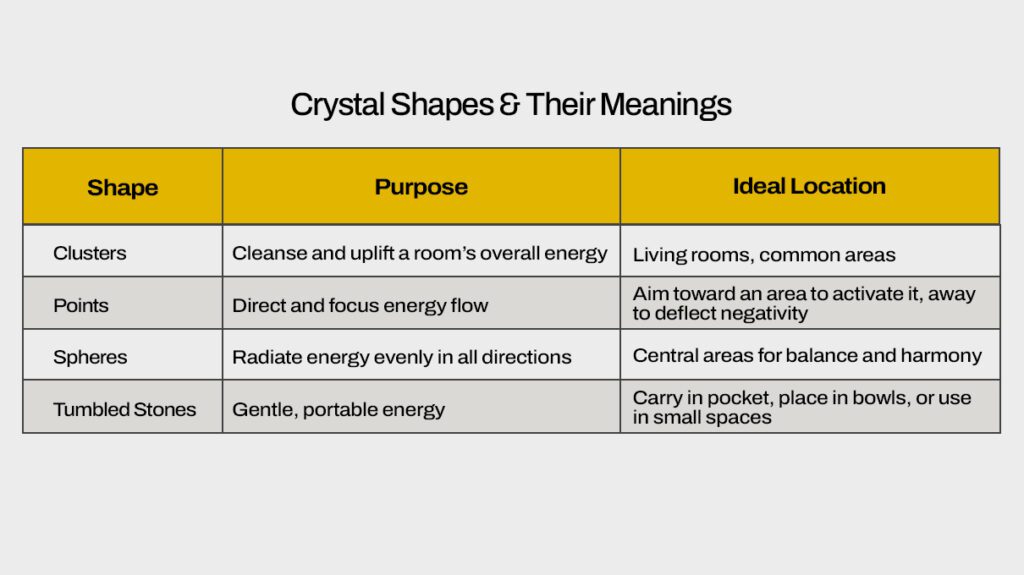
Crystal Shapes and Their Meanings
Crystals as Conscious Tools
Feng Shui crystals are not passive ornaments. They work through intention, placement, and partnership with you and your environment. When chosen thoughtfully, cleansed regularly, and positioned with purpose, they can harmonise and enhance the energy of your home or office.
As Kevin often reminds clients: “The crystal itself doesn’t create magic, it magnifies the intention behind it.”
Section 9 · Where to Learn Feng Shui?
Learning Feng Shui from credible sources can transform not only your living and working spaces, but also your overall outlook on life, health, and success.
With the arrival of Period 9 (2024 to 2043), the era of Fire, technology, and transformation, the demand for authentic, results-driven Feng Shui knowledge has never been greater. In this section, we explore trusted ways to study Feng Shui, from books and online courses to in-person training and YouTube channels.
Best Feng Shui Books (For Foundational Learning)
Books are a great starting point for building theoretical understanding. Here are a few highly recommended titles by Feng Shui Master, Kevin Foong:
- The Complete Idiot’s Guide to Feng Shui by Elizabeth Moran & Master Joseph Yu
An accessible introduction rooted in traditional principles, ideal for beginners. - Applied Pa-Kua and Lo Shu Feng Shui by Lillian Too
Clear visuals and step-by-step guidance make it perfect for visual learners. - Secrets of the Four Celestial Animals by Dr Stephen Skinner
A must-read for students keen to understand Landform Feng Shui, one of the most powerful foundations of the art. - Advanced Manuals on Flying Stars and Xuan Kong Da Gua
These texts are best explored under professional guidance. In Kevin Foong’s advanced programs, these systems are taught through real-world property case studies and Period 9 energy applications, ensuring both understanding and skill.
Note: Books provide theory, but Feng Shui is ultimately a living, experiential discipline. Learning under mentorship and through case-based practice is what turns knowledge into mastery.
Best Feng Shui Courses (Online Learning)
For global students, online programs offer flexibility without compromising depth.
Kevin Foong’s Feng Shui Mastery Online Program
- Covers San He Feng Shui, Qi Men Dun Jia, Eight Mansions, Flying Stars, Xuan Kong Da Gua, Landform Feng Shui, and Period 9 Feng Shui.
- Integrates BaZi analysis to match environmental energy with personal destiny.
- Features real-life property case studies audited by Kevin himself across 18 countries.
- Includes certification for those pursuing professional consultancy.
BaZi + Feng Shui Integration Program
- Combines Heaven Luck (BaZi) and Earth Luck (Feng Shui) for complete alignment.
- Helps students identify the best timing to activate wealth, health, and relationship opportunities.
These online courses are popular with property investors, business owners, and aspiring consultants seeking structured, lineage-based training that is practical and results-oriented.
Best Feng Shui Courses (In-Person Training)
For deeper mastery, Kevin Foong’s Feng Shui Mastery Retreats provide immersive, hands-on learning in Singapore and selected international cities.
Students learn to:
- Use the Luo Pan compass accurately on-site.
- Conduct real property audits (residential & commercial).
- Apply Period 9 activation techniques for wealth and business success.
- Receive direct mentorship and exclusive advanced methods not available online.
This is ideal for property developers, architects, real estate professionals, and serious students who want to practise Feng Shui at a professional level.
Best Feng Shui YouTube Channels
For continuous learning and inspiration, YouTube can be a valuable resource, provided you follow authentic classical teachers.
Highly Recommended
- Master Kevin Foong Official Channel: Offers practical teachings on Classical Feng Shui, BaZi forecasting, property walkthroughs, and Period 9 strategies.
- Julie Khuu: Interior designer who combines lifestyle aesthetics and Feng Shui principles for home harmony and design flow.
- Dear Modern : Architect and Feng Shui consultant known for modern, visual, easy-to-understand Feng Shui layouts.
Tip: Avoid “decor-style” channels that equate Feng Shui with interior design trends. True Feng Shui is based on Qi flow, direction, and timing, not just colour schemes or furniture placement.
Your Path to Mastery
If you are serious about learning Feng Shui, whether to improve your own environment or to become a certified consultant, follow this recommended progression:
- Start with books to understand the core theory.
- Join a structured online course to build applied skills.
- Advance through in-person training for real-world experience.
- Continue your journey through videos, community, and mentorship.
“Feng Shui is not just knowledge; it’s an ongoing relationship with energy. Learn the principles, observe your environment, and you’ll start seeing life change around you.”
— Master Kevin Foong
Section 10 · Popular Feng Shui Masters Around the World
Feng Shui is both ancient and evolving. Over the centuries, countless masters have interpreted its wisdom through their own lenses, from traditional scholars to modern corporate consultants. Here, we highlight six influential figures whose teachings have shaped how Feng Shui is practised in Asia and the West today.
3 Prominent Feng Shui Masters in Asia
1.Grand Master Yap Cheng Hai (1929–2004)
Legacy & School of Thought
Grand Master Yap Cheng Hai was one of the most respected names in modern Feng Shui. Based in Singapore, he was a leading authority on Flying Star (Xuan Kong Fei Xing) Feng Shui, a system that studies how the energy of a building changes over time.
He was instrumental in teaching and popularising this complex system globally through the Yap Cheng Hai Academy, leaving behind a lasting lineage of certified practitioners.
Methodology & Focus
- Precision in Timing: Used Flying Star charts to analyse time-based energy cycles.
- Accuracy in Facing Direction: Emphasised detailed compass readings to understand how Qi flows into a property.
- Practical Remedies: Offered clear, actionable solutions to activate auspicious stars and neutralise unfavourable ones.
Influence & Reach
While he advised many corporate clients, his biggest legacy lies in education. His students continue to practise worldwide, making his system one of the most influential schools in contemporary classical Feng Shui.
2.Master Hong Chuan (Taiwan)
Legacy & School of Thought
Master Hong Chuan is a highly regarded Feng Shui master and scholar from Taiwan, best known for his expertise in Bazhai Mingjing (Eight Mansions) and Xuan Kong Feng Shui. His textbooks are considered essential references for serious students.
Methodology & Focus
- Scholarly Depth: Deeply grounded in classical Chinese texts; known for clarifying complex, often misunderstood principles.
- Eight Mansions Mastery: A recognised authority on the East/West Group classification method.
- Integrated Analysis: Combines multiple systems (e.g. Flying Star + Eight Mansions) for more complete readings.
Influence & Reach
Master Hong Chuan is regarded as a “master’s master,” respected by peers for his intellectual rigour and clarity. His client base spans individuals and corporations across Taiwan and Southeast Asia.
3.Master Kevin Foong (Singapore)
Profile & Reputation
Master Kevin Foong is an internationally acclaimed Feng Shui authority based in Singapore. His clientele spans 18 countries, including Fortune 500 companies and world-renowned brands such as CNBC, Shiseido, HSBC, DBS, Singapore Airlines, and Marriott.
By his late twenties, Kevin had already built a multi-million-dollar consultancy recognised for its precision and corporate impact.
Methodology & Expertise
Kevin’s work stands out for blending depth, accuracy, and strategic application. He is trained across multiple classical systems, including:
- San He Landforms Feng Shui and San Yuan Flying Stars (Xuan Kong Fei Xing)
- Qi Men Dun Jia for advanced divination and timing
- Bazi (Four Pillars of Destiny) and Zi Wei Dou Shu (Purple Star Astrology)
- Face Reading and Palm Reading for personal destiny insights
Influence & Impact
Kevin’s reputation as a trusted advisor for major corporations and high-net-worth individuals reflects a unique mastery of combining traditional Feng Shui principles with modern business intelligence.
A Final Note on Selection (Asia)
When selecting a Feng Shui consultant, it is not about finding “the best master,” but rather the one whose methodology and communication style align best with your goals.
3 Influential Feng Shui Masters in the West
While Feng Shui originated in ancient China, it has been successfully adapted and translated for Western audiences by several key figures. These masters bridge tradition with modern psychology, wellness, and design.
1.Marie Diamond (Belgium / USA)
Background & Influence
Known globally for her appearance in The Secret, Marie Diamond is one of the most recognisable Western Feng Shui masters. Her unique system, Diamond Feng Shui®, combines traditional Feng Shui with modern transformation tools.
Methodology & Focus
- Consciousness & Intention: Believes the most powerful Feng Shui tool is awareness itself.
- Light, Colour & Crystals: Uses frequencies of light and colour to shift a space’s vibration.
- Personal Transformation: Aims to align a person’s outer environment with their inner goals.
Why She’s Popular: Marie’s method appeals strongly to the Western spiritual and personal development community, blending Feng Shui with the Law of Attraction and mindfulness.
2.William Spear (United States)
Background & Influence
William Spear is one of the pioneers who brought Feng Shui to the U.S. in the 1980s. Coming from a healthcare background, he focuses on the deep link between our surroundings and our well-being.
Methodology & Focus
- Feng Shui as Healing: Treats environmental balance as a pathway to better physical and emotional health.
- I Ching Foundation: Grounds his practice in the philosophy of the I Ching (Book of Changes).
- Practical Application: Known for simplifying Feng Shui with humour and relatable examples.
Why He’s Popular: Spear’s pragmatic and health-oriented approach makes Feng Shui feel logical and accessible to Western audiences, removing superstition and emphasising results.
3.David Daniel Kennedy (United States)
Background & Influence: David Daniel Kennedy is a respected author and educator known for teaching authentic Feng Shui to Western audiences in a clear, structured way.
Methodology & Focus
- Bridging East & West: Simplifies complex schools like Flying Star and Eight Mansions for English-speaking students.
- Results-Oriented: Focuses on practical outcomes: better relationships, health, and career.
- Structured Learning: Offers books and courses that turn classical techniques into easy, step-by-step systems.
Why He’s Popular: Kennedy is trusted by serious students who want more than “decorative Feng Shui.” His teachings make authentic, technical Feng Shui approachable for everyday people.
A Final Note on Selection (West)
These Feng Shui masters show how adaptable Feng Shui can be:
- Marie Diamond merges energy work with consciousness and manifestation.
- William Spear focuses on healing and wellness.
- David Daniel Kennedy teaches structure and clarity.
Together, they demonstrate that Feng Shui transcends culture: offering universal tools for harmony, productivity, and growth wherever you are in the world.
Section 11: How to Choose a Feng Shui Master (Singapore & Beyond)
Choosing the right Feng Shui consultant can feel overwhelming. With so many practitioners and differing approaches, it is important to know how to separate genuine expertise from commercial hype.
Whether you are engaging a master in Singapore or abroad, this section will help you make a confident, informed decision. A credible Feng Shui master should demonstrate:
1.Verifiable Lineage or Training
The most respected masters can trace their education to a recognised lineage or academy, ensuring they follow structured, time-tested systems.
Example: Master Kevin Foong trained under several world-renowned classical masters and studied both San He Landforms and San Yuan Flying Stars (Xuan Kong Fei Xing) Feng Shui. Kevin also went through formal training through Taiwanese lineage Feng Shui masters.
2.Proven Track Record & Experience
Look for years of hands-on consulting backed by client testimonials and visible results.
Example: Kevin Foong has more than 15 years of professional practice, serving Fortune 500 companies, luxury brands, and homeowners across 18 countries.
3.Comprehensive Knowledge Across Systems
A skilled master should understand several classical schools and combine them effectively.
Example: Kevin Foong is proficient in Flying Star, Eight Mansions, Bazi (Four Pillars of Destiny), Qi Men Dun Jia, and Zi Wei Dou Shu (Purple Star Astrology), giving him a complete view of both property and personal energy.
4.Professionalism & Transparency
From clear communication and punctuality to structured reports and fair pricing, professionalism builds trust.
Example: Kevin Foong is known for detailed written analyses, transparent consultation steps, and practical explanations that help clients understand the logic behind every recommendation.
5.None of these Red Flags
Be cautious if a consultant shows any of these warning signs:
- Guarantees of Specific Outcomes: Feng Shui improves potential; it doesn’t promise wealth or marriage.
- Fear-Based Tactics: Ethical masters empower you instead of scaring you into buying “cures.”
- Over-Reliance on Selling Objects: Genuine Feng Shui rarely requires expensive figurines or crystals.
- Vague or Generic Advice: Tips like “add plants for luck” or “paint your door red” without analysing your home’s chart aren’t authentic.
- Lack of Transparency: A reliable master will always explain the reasoning behind recommendations.
Before engaging a Feng Shui Master, you also need to understand the difference between Personalised Consultation and Generic Tips:
Generic Tips (What to Avoid)
- Based only on the Bagua map or décor rules that ignore your unique layout and birth data.
- Often one-size-fits-all and can even conflict with your home’s real energy chart.
Personalised Consultations (What to Look For)
A professional master will:
- Take a precise Luo Pan (compass) reading of your property’s facing direction.
- Note the construction period or period number.
- Request birth dates and genders of occupants to calculate Bazi and Gua numbers.
- Provide detailed, personalised recommendations, such as which areas of your home to focus on for wealth or harmony, which areas to keep calm, and the best timing for important changes.
Example: Kevin Foong combines these steps in every consultation, aligning architectural energy with each occupant’s personal chart to deliver practical, measurable results.
Beyond qualifications, the right Feng Shui master should make you feel comfortable and respected. Choose someone whose explanations make sense and whose approach feels balanced. As Kevin often says:
“A good Feng Shui consultation should empower you to understand your environment and not depend on someone else to fix it.”
Section 12: Frequently Asked Questions About Feng Shui
Navigating the world of Feng Shui can bring up many questions. Here, we answer some of the most common ones, blending classical wisdom with practical, modern understanding.
General Questions Around Feng Shui
Is Feng Shui real or just superstition?
This is one of the most common questions and also one of the most misunderstood.
The Scientific Perspective:
While Feng Shui can’t always be measured in a lab, it aligns closely with environmental psychology, the study of how surroundings influence our mood, focus, and well-being. A cluttered or poorly lit room makes most people feel drained; an organised, bright, and well-ventilated space naturally lifts energy.
The Energetic Perspective:
Traditionally, Feng Shui is about managing Qi (life-force energy): the invisible current that flows through all living things and environments. It is a structured method of improving that flow using layout, light, and balance.
The Verdict: Feng Shui is neither blind superstition nor pure science. It is an ancient form of environmental design, grounded in observation and harmony. The positive outcomes many people experience such as better sleep, reduced stress and improved focus are very real, even if different cultures explain them in different ways.
What is the Easiest Way to Start Applying Feng Shui at Home?
You don’t need to be an expert to begin. Start with these five practical steps (expanded from Section 5: Home Feng Shui Best Practices):
- Declutter ruthlessly. Stagnant items block energy flow and mental clarity.
- Focus on the main door. Keep it clean, bright, and easy to open. It is where new energy enters.
- Apply the Command Position. Position your bed and desk with a wall behind you and a view of the door (but not directly in line).
- Fix what’s broken. Leaks, flickering lights, or cracked walls symbolise energy loss.
- Bring in nature. Healthy plants invite vitality, oxygen, and calm.
Pro Tip: Once the basics are in place, you can explore the deeper techniques in Section 5 and Section 6 for detailed home and office Feng Shui.
What Should I Avoid in Feng Shui?
Common mistakes that disrupt energy flow include:
- Bed under a window – lacks support, leading to poor rest.
- Desk with your back to the door – creates tension and distraction.\
- Mirror facing the bed – doubles energy, disturbing sleep.
- Stove opposite sink or fridge – Fire and Water elements clash, symbolising wealth or health conflict.
- Sharp corners pointing at you (“poison arrows”) – create cutting energy. Soften them with plants or fabric.
Which Direction Should My Bed Face?
There’s no universal “best direction.”
- Generic online advice like “face north” or “face east” oversimplifies Feng Shui.
- The accurate method uses your Gua (Kua) number, derived from your birth date and gender, to identify four auspicious directions for you personally.
- The simplest rule of thumb: prioritise the command position: wall behind, view of the door, over compass direction. Stability and comfort matter most.
You can learn more about the Gua system in Section 3: Eight Mansions (Ba Zhai).
Is Feng Shui Popular in Singapore?
Yes it’s deeply woven into modern Singaporean life.
- Corporate culture: Businesses large and small consult Feng Shui masters before signing leases, renovating, or launching.
- Real estate: Developers engage masters for orientation, layout, and even groundbreaking dates.
- Homes: Many families apply simple Feng Shui principles in their HDB flats and private residences.
In Singapore, Feng Shui is considered a form of strategic design and planning.
Practical Feng Shui Questions
What Is a Feng Shui Calendar (Tung Shing / Tung Shu)?
Also called the Chinese Almanac, it helps choose auspicious dates and times for important activities: weddings, renovations, moves, business launches, etc.
Misconception:
Any date marked “lucky” is good for everyone.
Reality:
A professional cross-references the almanac with your Bazi chart (birth data) and your property’s Flying Star chart to find a date that aligns with both personal and environmental energy.
What Are Feng Shui Lucky Numbers?
Numbers carry cultural symbolism in Chinese tradition.
- 8 (八, bā) sounds like “prosperity” (發, fā) → seen as very lucky.
- 4 (四, sì) sounds like “death” (死, sǐ) → often avoided.
While fun and meaningful, lucky numbers are minor enhancers, not main solutions.
The energy of your layout, cleanliness, and orientation has far greater impact than the number on your door.
Can a Haircut Affect My Feng Shui?
Some follow the Tung Shing to avoid haircuts on “inauspicious” days, such as during Lunar New Year.
This is a folk custom, not part of classical Feng Shui.
Your home and workspace have a far stronger effect on your daily energy than the timing of your haircut.
Are Feng Shui and Vastu the Same?
No they share similar goals but come from different traditions.
- Feng Shui (China) focuses on Qi flow, Yin–Yang balance, and Five Elements.
- Vastu Shastra (India) is based on the Pancha Bhootas (five elements) and directional deities, using a fixed spatial grid.
Mixing them without deep study can cause confusion. It is best to follow one system consistently.
What is the meaning of a Feng Shui Elephant?
The elephant is a cultural symbol of strength, wisdom, and protection.
In Feng Shui, pairs of elephants are often placed near entrances to guard the home.
Reality check: The statue itself doesn’t generate energy; its effectiveness depends on your intention and placement.
It’s a symbolic enhancer, not a cure for poor room design or clutter.
How Should I Use a Feng Shui Fountain?
Water represents wealth and opportunity in Feng Shui, but placement is critical.
Do:
- Keep the water clean and moving.
- Position it after checking your Flying Star chart to ensure it supports current-period energies.
Don’t:
- Place water randomly; wrong sectors can trigger loss, legal issues, or health problems.
Always consult a qualified Feng Shui master before installing large water features.
Advanced & Misunderstood Topics Around Feng Shui
Can Feng Shui Really Change My Luck?
Feng Shui doesn’t replace effort or destiny. Instead, it creates an environment that supports your goals, making it easier for opportunities to flow and for you to perform at your best.
As Kevin often says: “Feng Shui doesn’t create miracles, it creates alignment.”
Can Feng Shui Help in Business or Career?
Absolutely. See Section 6: Office Feng Shui Best Practices, where desk placement, layout, and lighting influence focus, teamwork, and decision-making.
Many multinational firms in Singapore apply Feng Shui for office design, client-facing areas, and staff well-being.
What’s the Difference Between Classical and Modern Feng Shui?
- Classical Feng Shui (like what Master Kevin Foong practises) is based on ancient Chinese texts, compass readings, and time-based energy cycles.
- Modern or “Western” Feng Shui focuses more on symbolism, colours, and intention.
Both can be helpful, but classical methods are more data-driven and precise. Hence, they are more ideal for long-term, measurable results.
How Often Should I Update My Feng Shui?
Energy changes over time, especially with Flying Star Feng Shui, where cycles shift every year and major periods every 20 years.
Kevin recommends a light annual review and a comprehensive analysis every new period to stay aligned with changing Qi.
Final Thoughts
Feng Shui is both an art and a science. The goal isn’t to follow rigid rules, but to create spaces that feel balanced, supportive, and aligned with your life goals.