
Feng Shui is one of the most misunderstood practices in the modern world.
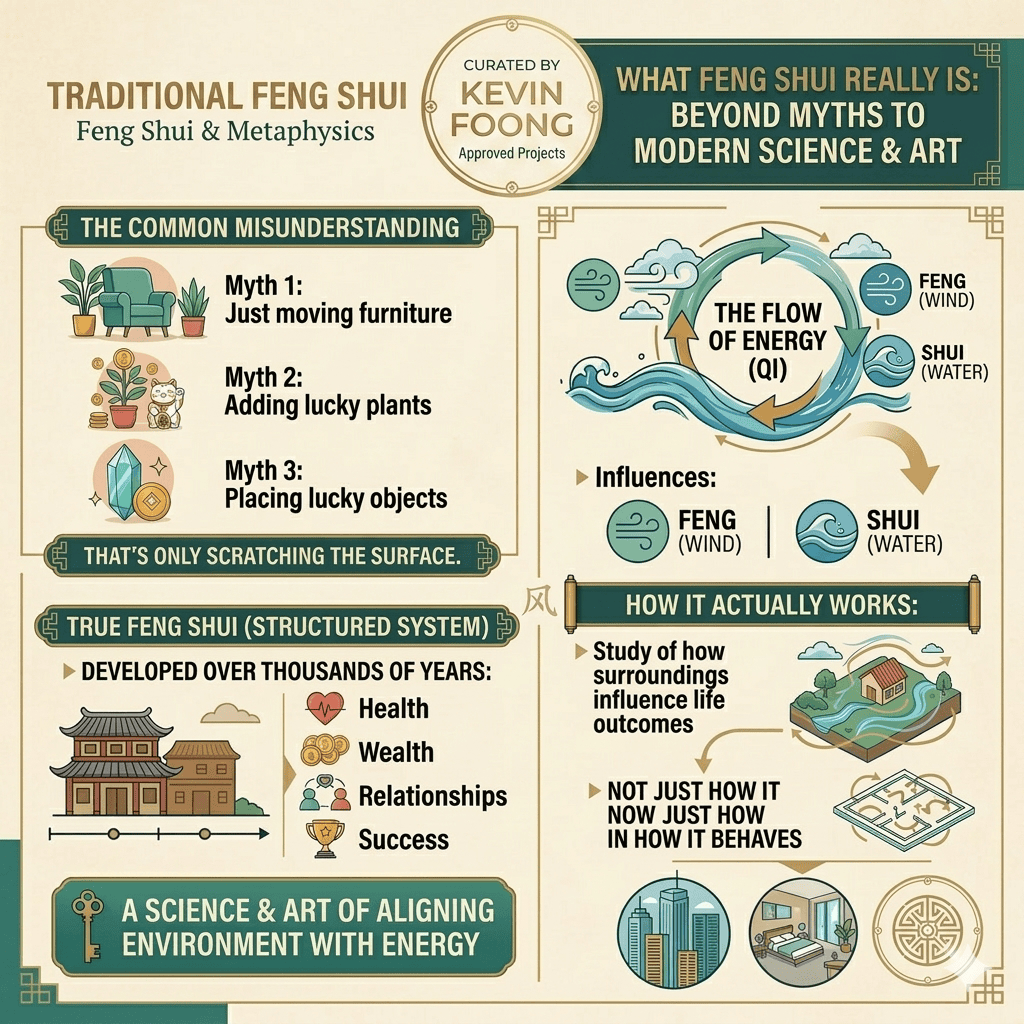
Ask most people, and they’ll tell you it’s about moving furniture, adding plants, or placing lucky objects in your home.
That’s not entirely wrong — but it’s only scratching the surface.
True Feng Shui is a structured system of environmental analysis developed over thousands of years to influence health, wealth, relationships, and long-term success.
This guide will break down:
- What Feng Shui really is
- How it actually works
- The difference between real Feng Shui vs popular myths
- And how it can be applied in today’s modern world
What Is Feng Shui?
Feng Shui (风水) literally translates to “Wind” (Feng) and “Water” (Shui).
These two elements represent the flow of energy (Qi) in the environment.
At its core, Feng Shui is the study of how your surroundings influence your life outcomes.
Not just how a space looks — but how it behaves.
The Real Definition
Feng Shui is:
The science and art of aligning your environment with natural energy patterns to improve life results.
This includes:
- Your home
- Your office
- The land around you
- Directional orientation
- Time-based energy cycles
The Foundation of Feng Shui: Qi (Energy Flow)
Everything in Feng Shui revolves around Qi (气) — the invisible life force that flows through all spaces.
When Qi flows smoothly:
- Opportunities increase
- Health improves
- Relationships stabilize
- Wealth becomes easier to accumulate
When Qi is blocked or chaotic:
- Stress increases
- Financial issues appear
- Conflicts arise
- Progress feels stuck
Feng Shui is essentially about managing the quality and movement of Qi.
The Three Core Systems of Authentic Feng Shui
Most online articles simplify Feng Shui into decoration tips.
But real Feng Shui is built on three technical pillars:
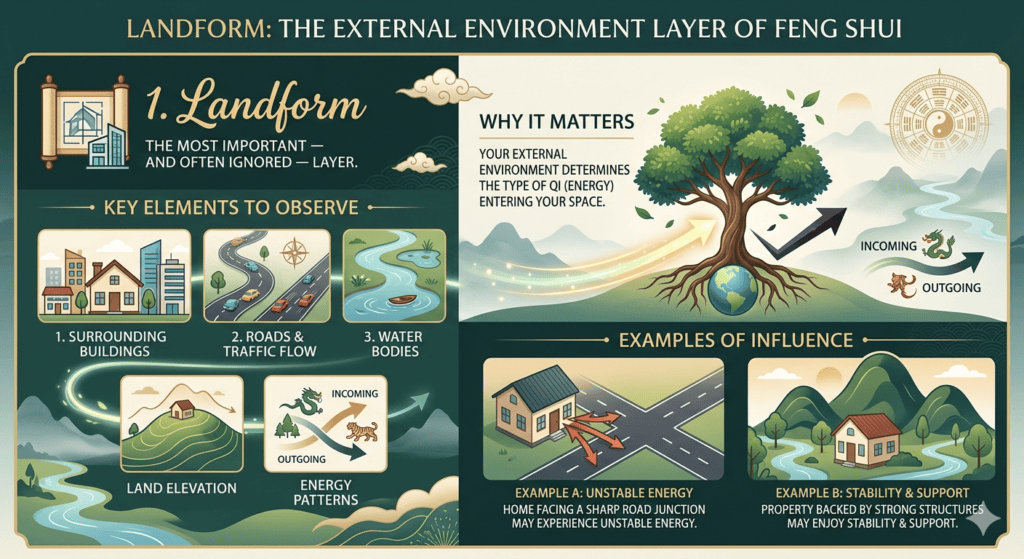
1. Landform (External Environment)
This is the most important layer — and often ignored.
It looks at:
- Surrounding buildings
- Roads and traffic flow
- Water bodies
- Land elevation
- Incoming and outgoing energy patterns
Why it matters:
Your external environment determines the type of Qi entering your space.
Example:
- A home facing a sharp road junction may experience unstable energy
- A property backed by strong structures may enjoy stability and support
2. Compass School (Directional Analysis)
This involves precise compass measurements to determine energy distribution.
Key tools:
- Luo Pan (Feng Shui compass)
- Eight Mansions (Ba Zhai)
- Flying Stars (Xuan Kong Fei Xing)
What it affects:
- Which sectors influence wealth, health, relationships
- Best directions for sleeping, working, or entrance placement
This is where Feng Shui becomes mathematical and systematic, not guesswork.
3. Time Dimension (Flying Star System)
Feng Shui is not static.
Energy changes over time in cycles called Periods.
We are currently in Period 9 (2024–2043) — dominated by Fire energy.
Why this matters:
- A house that was good before may no longer perform now
- Certain industries and opportunities rise or fall based on cycles
This is why serious Feng Shui requires re-audits over time, not one-time fixes.
The Five Elements Theory
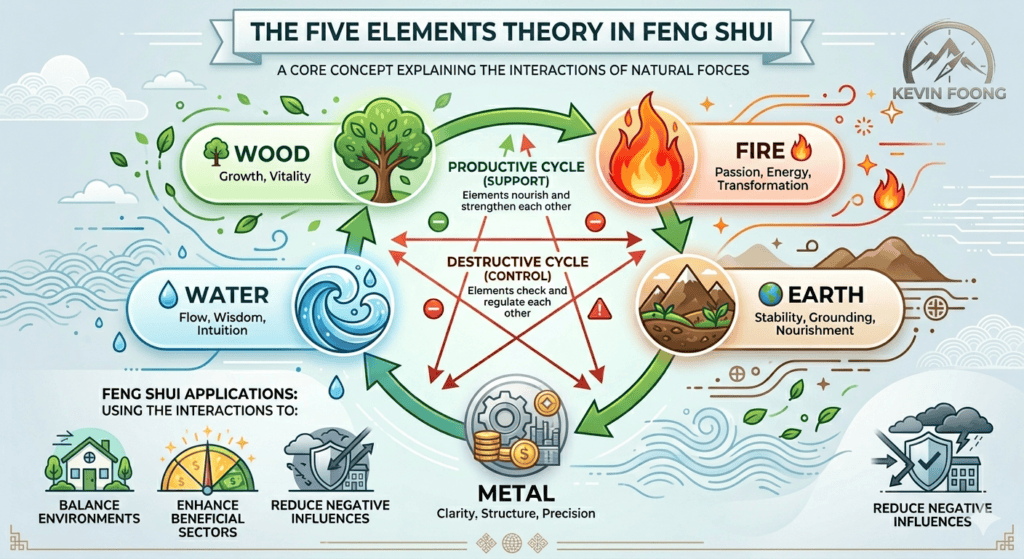
Another core concept is the interaction of the Five Elements:
- Wood 🌳
- Fire 🔥
- Earth 🌍
- Metal ⚙️
- Water 💧
These elements:
- Support each other (productive cycle)
- Control each other (destructive cycle)
Feng Shui uses these interactions to:
- Balance environments
- Enhance beneficial sectors
- Reduce negative influences
Common Feng Shui Myths (And the Truth)
Myth 1: Feng Shui Is Just Interior Design
Reality:
Feng Shui is not about aesthetics.
A beautifully designed home can still have poor Feng Shui — and vice versa.
Myth 2: Decluttering Alone Fixes Everything
Reality:
Decluttering helps improve comfort, but it does not correct structural energy issues.
It’s like cleaning your car but ignoring a faulty engine.
Myth 3: Lucky Objects Bring Wealth
Reality:
No object can replace:
- Proper orientation
- Correct energy flow
- Strong environmental support
Objects may enhance — but they don’t create results on their own.
Myth 4: Feng Shui Is Superstition
Reality:
Modern Feng Shui, when applied correctly, is:
- Logical
- System-based
- Measurable through life outcomes
It’s not about belief — it’s about alignment with environmental forces.
What Can Real Feng Shui Improve?
When done correctly, Feng Shui can impact:
1. Wealth & Financial Growth
- Better business opportunities
- Increased income stability
- Improved decision-making
2. Career & Opportunities
- Stronger authority and recognition
- Faster career advancement
- Better partnerships
3. Relationships
- Reduced conflicts
- Stronger emotional connection
- Improved social support
4. Health & Well-being
- Better sleep quality
- Reduced stress
- Improved physical vitality
How Feng Shui Works in the Modern World
Today, Feng Shui is used by:
- Homeowners
- Business owners
- Property developers
- Corporations
Because one truth remains:
Your environment either supports you — or works against you.
In high-performance environments (like offices or corporate spaces), Feng Shui is used to:
- Improve productivity
- Enhance decision-making clarity
- Strengthen leadership positioning
The Difference Between Real Feng Shui vs Pop Feng Shui
| Pop Feng Shui | Real Feng Shui |
|---|---|
| Focus on décor | Focus on structure & energy |
| Based on trends | Based on calculations |
| One-size-fits-all | Customized analysis |
| Symbolic fixes | Strategic adjustments |
| Short-term feel | Long-term results |
Why Feng Shui Matters More Than Ever Today
In a fast-paced world, people focus heavily on:
- Skills
- Strategy
- Effort
But often ignore the environment they operate in.
Yet your environment is the silent multiplier.
Two people can:
- Work equally hard
- Have similar skills
But achieve very different results — simply because of their environment.
Final Thoughts: Real Feng Shui Is About Results, Not Belief
Feng Shui is not about:
- Luck
- Rituals
- Superstition
It is about positioning yourself in the right environment to succeed.
When your environment is aligned:
- Things flow
- Opportunities come easier
- Life becomes more efficient
When it’s not:
- You struggle harder for the same results
Want to Apply Real Feng Shui the Right Way?
If you’re serious about results, Feng Shui should not be approached casually.
It requires:
- Proper analysis
- Accurate measurements
- Strategic implementation
At Kevin Foong Consulting, the focus goes far beyond surface-level adjustments — whether it’s for your home or office.
We prioritize:
- Selecting the right landform — because the external environment determines the quality of Qi entering your space
- Precise directional and time-based analysis — ensuring your property is aligned with current energy cycles
- Full interior energy alignment — optimizing layout, sectors, and usage to activate the highest potential for both living environments and business spaces
This approach applies to:
- Homes Feng Shui → for health, relationships, and long-term wealth stability
- Offices & commercial spaces → for business growth, leadership strength, and financial performance
All of this is done without relying on Feng Shui objects or symbolic cures, but through real structural alignment and environmental mastery.
Because true Feng Shui is not about adding items —
it’s about positioning yourself correctly within the energy of your environment.
At the end of the day:
You don’t rise only because of effort — you rise because of alignment.